SALIENT
FEATURES
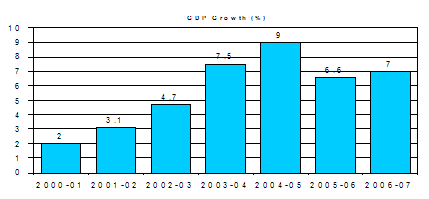
Pakistan’s economy continues to maintain its strong growth momentum for the fifth year in a row in the fiscal year 2006-07. With economic growth at 7.0 percent in the current fiscal year, Pakistan’s economy has grown at an average rate of almost 7.0 percent per annum during the last five years.
 GDP
GDP
Real GDP grew at 7.0 percent in 2006-07
as against the revised estimates of 6.6 percent for last year and 7.0 percent
growth target for the year.
GDP GROWTH
CONTRIBUTION TO REAL GDP GROWTH
Agriculture
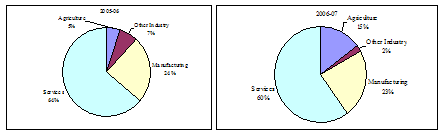
The performance of agriculture remained weak during
2005-06 because its crops sector particularly major crops could not perform up
to the expectations. Growth in the agriculture sector registered a sharp recovery
in 2006-07 and grew by 5.0 percent. Major crops posted strong recovery from
negative 4.1 percent last year to positive 7.6 percent, mainly due to higher
production of wheat and sugarcane. Wheat production of 23.5 million tons is
highest ever in the country’s history. Sugarcane production likewise improved
by 22.6 percent over last year to 54.8 million tons.
Manufacturing
Overall manufacturing recorded growth of 8.45 percent,
against last year’s growth of 9.9 percent. Large-scale manufacturing,
accounting for 69.5 percent of overall manufacturing registered growth of 8.75
percent in the current fiscal year 2006-07 against last year’s achievement of
10.68 percent. There has been a slight decline in growth in the manufacturing
sector due to multiple reasons.
Performance of public sector industries
(exclucluding Pak Steel) (July-June) (Rs. in Million) |
|
|
|
2005-2006 |
2006-2007 (Expected) |
Increase/Decrease % |
Production
Value* |
3,879 |
3,998 |
3.07 |
Net Sales |
4,825 |
5,358 |
11.05 |
Pre-tax profit |
9 |
-5 |
-155.56 |
Taxes and duties |
360 |
355 |
-1.39 |
No. of
employees** |
5,491*** |
5,032 |
-8.36 |
|
|
|
|
|
|
|
|
|
*Production
value of PACo is at current prices. NFC & SEC are at constant prices of
1999-2000 and 1992-93 respectively |
**Including daily
wagers |
|
|
|
|
|
|
***Excluding
holding corporations |
|
|
|
|
Investment
The investment rate is on the rise since 2004-05,
reaching as high as 23 percent of GDP in 2006-07. The composition of investment
between private and public sector has changed considerably during the last
three years. The overall foreign investment during the first ten months
(July-April) of the current fiscal year has touched $ 6 billion.
Inflation
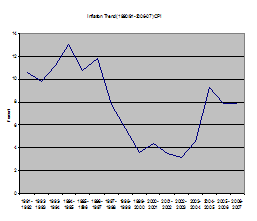
During the first ten months of the current year
2006-07 (July—April) averaged at 7.9 percent. This is a slight improvement
over last fiscal year where 2005-06 (July—April) inflation stood at 8.0
percent. Unlike previous years, the inflation in the current year was
primarily driven by food prices. Food inflation in turn, was principally
based on increase in prices of a few items such as rice, edible oil, meat,
pulses, tea, milk, fresh vegetables and fruits.
Stock Market
Pakistan’s capital and
stock markets have witnessed impressive growth over the last several years. The
KSE-100 index (Pakistan’s benchmarked stock market) has increased from 1521
points in June 2000 to 12370 points in April 2007 – a rise of over 10,800
points or an increase of 713 percent. Similarly aggregate market capitalization
has increased from Rs 392 billion ($7.6 billion) in June 2000 to Rs 3604
billion ($ 59.4 billion) in April 2007, showing a rise of over Rs 3200 billion
($ 53 billion) or an increase of 819 percent.
Per Capita Income
Pakistan’s per capita real
GDP has risen at a faster pace during the last four years (5.5% per annum on
average in rupee terms). The main factor responsible for the sharp rise in per
capita income include acceleration in real GDP growth, stable exchange rate and
four fold increase in the inflows of workers’ remittances.
Trade Deficit
The slower growth in imports is likely to improve
trade deficit from 9.5 percent of GDP last year to 9.0 percent this year.
Foreign Direct Investment
Almost 78 percent of FDI has come from five countries,
namely, the UAE, US, China, UK and Netherlands. If we look at sectoral breakup,
the communication sector (including telecom) spearheaded the FDI inflows
followed by financial business, energy including oil gas and power and food,
beverages and tobacco.
Foreign Exchange Reserves
Pakistan’s total
liquid foreign exchange reserves stood at $ 13,738 million.
External Debt
Pakistan has reduced its
public debt burden (including Rupees debt and foreign currency debt) from 100.3
percent of GDP in end-FY99 to 53.4 percent of GDP by end-March FY07.
Remittances
Workers’ remittances, the third largest source of foreign
exchange inflows after exports and foreign investment, continue to maintain its
rising trend. Workers’ remittances totaled $ 4.45 billion in the first ten
months (July-April) of the fiscal year as against $ 3.6 billion in the same
period last year, depicting an increase of 22.6 percent.
Current Account Deficit
Current account deficit is expected to be around 5.0
percent of GDP as against 4.4 percent last year. The strong inflows in capital
account will more than offset the current account deficit and add to the stock
of foreign exchange reserves.
Privatization
During the period July 2006 to February 2007, the privatization
commission completed five transactions that fetched an amount of Rs. 67.664 billion.
OGDCL’s 10 percent listing and domestic offering was over subscribed yielding a
total of $811 million.
Assets Privatized During FY 07 |
Assets |
Value |
OGDCL (GDR &
domestic offering) |
Rs. 46.963
billion |
Pak American
Fertilizers (shares) |
Rs. 15.949
billion |
Javedan Cement
Limited |
Rs. 4.316
billion |
Lyallpur Chemical & Fertilizers |
Rs. 0.280
billion |
Lasbella Textile
Mills |
Rs. 0.156
billion |
|
|
|
|
Source : Privatization Commission |
|
|
|
|
|
|
Balance of Payments
Pakistan’s balance of
payments shows a record increase in capital flows that has substantially offset
a gradual widening of the current account deficit. The magnitude of the inflows
has overwhelmed the State Bank of Pakistan and complicated monetary policy. Pakistan’s current account deficit further widened to $ 6.2 billion (4.3% of GDP) in the
first nine months (July-March) of the current fiscal year from $ 4.6 billion
(3.6% of GDP) in the same period last year.
COMMENTS
- It
has been stated that hydel electricity (dams) cost over 4.5 cents per unit
while the thermal electricity cost over 12.5 cents to 14 cents per unit;
but cost of the time-frame for dams versus thermal units and the cost of
land that is already under cultivation and becomes useless due to salinity
may also be considered.
- It
is stated that per capita income has increased in dollar terms, at an
average rate of 13% during last five years. Furthermore, as stated, main
factor responsible for sharp rise in per capita income, amongst other
things, is a fourfold increase in the inflow of worker’s remittances. This
gives rise to the question that the income of the local masses may have
remained constant or even decreased but it is the remittances of the lucky
few who are abroad and sending their earnings to Pakistan. This is painting a misguiding rosy picture of per capita income increase of the poverty
stricken masses.
- Sugarcane
production last year is stated to be highest in the history of the country
whereas sugar prices could not fall back anywhere near the Rs. 19 per kg
prices from where the sugar crisis took it to the highest in the history
of the country. The complete picture of sugar production rise fall rise is
given below:
1. 1998-99 54
million tons
2. 2000-01 44
million tons
3. 2003-04 53
million tons
4. 2005-06 45
million tons
5. 2006-07 55
million tons
- Wheat
production of 23.5 million tons is said to be highest ever in the history
of the country whereas wheat flour per 10 kg bag (Ashrafi brand), today,
stands at an all time high of Rs.165/=
- The
constant load shedding in the country is one of the enormous speed
breakers for the progress and prosperity of the manufacturing sector but
in the economic survey – in the relevant section, it has not been
highlighted as a major reason for lower production.
RECOMMENDATIONS
The
theory of balanced growth states that there should be simultaneous and
homogeneous development of different sectors of the economy so that all sectors
grow in union.
According
to Nurks, the vicious circles of poverty are at work in underdeveloped
countries which retard economic development. If, however, the vicious circles
are broken, economic development will follow.
The
vicious circles of poverty can be broken by simultaneous investment in a large
number of industries with balanced growth. The doctrine of balanced growth
requires a balance between investment in agriculture and industry, as both are
complimentary. If employment increases in the industrial sector, it will lead
to an increase in demand of foodstuff which will require, in turn, the
expansion of agriculture output.
It
is important that the agriculture sector must develop and progress along with
the industrial sector, otherwise inflation will set in. A balance is also required
between the domestic and foreign sector. The need of the time is also to see as
to where the proceeds of privatization, being capital in nature, are utilized.
i.e. whether the sale of assets – being capital assets are used to retire long
term debts or are spent away in contingency expenditure.































 Mr. Gohar Manzoor